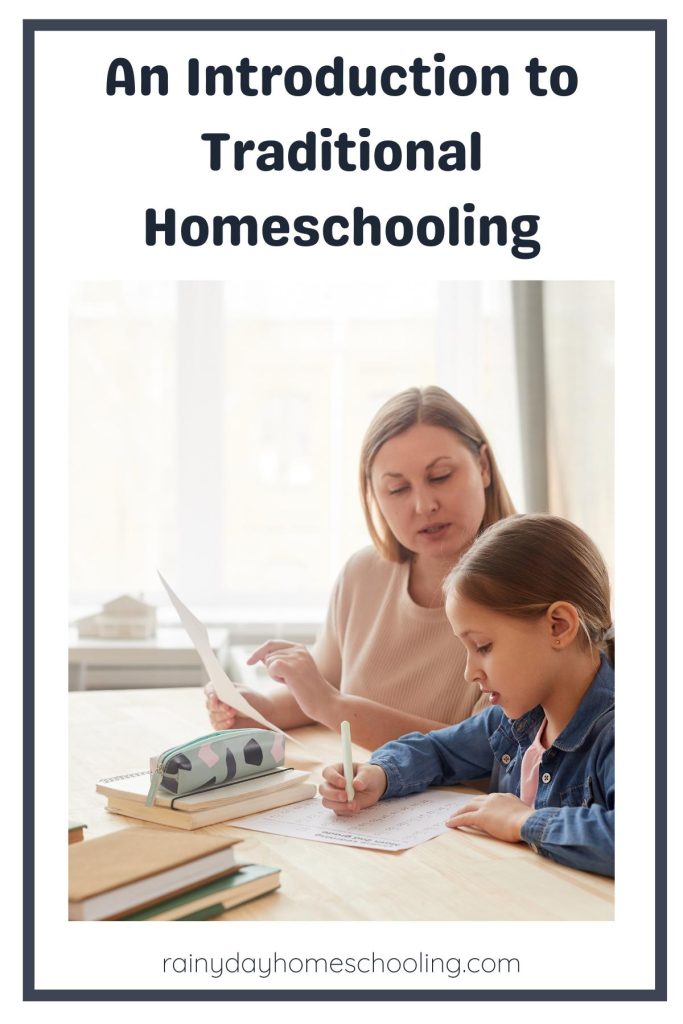
Getting Started with Traditional Homeschooling: A Guide for New Home Educators
Embarking on the journey of homeschooling can be both exciting and overwhelming, especially for new home educators. If you are considering or have chosen the path of traditional homeschooling, where structured teaching methods are employed, I’m here to help you. I will provide you with practical tips, insights, and resources to help you navigate the first stages of your structured homeschooling journey. Let’s dive in and discover how to get started with confidence and enthusiasm!

Understanding the Philosophy of Traditional or Structured Homeschooling
The philosophy of traditional homeschooling is rooted in the belief that a structured and disciplined approach to education is beneficial for children’s academic and personal development. This philosophy draws inspiration from traditional educational methods employed in formal school settings, adapting them to the homeschool environment.
Core Subjects
There is an emphasis on Core Subjects such as Mathematics, English Language, Science and History. Which is typically taught from a structured curriculum following grade levels as they would in school.
In our own home educating journey we did this exclusively for mathematics following the school-based year group expectations. It was the one subject that I felt would be hardest to jump into as the learning develops over time based on previous knowledge and skills.
Structured Learning
One of the defining characteristics of traditional homeschooling is the use of structured learning very similar to how a teacher would plan for them in school. Lessons are planned in advance, and a predetermined curriculum or textbook is followed.
Set Curriculum
There are many different curriculums available for home educators and you can find ones that align with your educational goals and your family values. For us, it was a secular curriculum for mathematics. I wanted a framework that provided a structured sequence of lessons, topics and also assessment opportunities regularly.
Scheduled Learning Time
In families that follow traditional homeschooling fully, there is a regular schedule for learning, similar to how a school day would be structured. It’s followed to help establish a routine, create good discipline and ensure that everything is covered properly.
Read our guide on Routines, schedules and planning your homeschool days to get started with this.
For us where we only took the traditional homeschooling route for 1 subject, it meant that I set aside table time each morning we were at home to cover our curriculum. But, when we first started it was very different, the kids had come out of school and were used to the routine of it so our first few weeks instead of deschooling (we’d just had a very long summer break) we jumped into a full week scheduled and started with a more traditional homeschooling day.
Teacher-Led Instruction
Parents assume the role of primary educators in traditional homeschooling. They provide direct instruction to their children, explaining concepts, guiding learning activities, and assessing progress.
Having taught in the past I felt most comfortable at first with this and in mathematics it was the one thing I actively taught as I would have in school. Not on a huge whiteboard but a little one that we could share at the table.
Assessments and Grades
Traditional homeschooling often incorporates assessments and grades to measure a child’s progress. This may include periodic quizzes, tests, projects, and assignments. Assessments serve as a means of evaluating comprehension, identifying areas of improvement, and providing feedback on the child’s academic performance. You do need to check what is required by your state or country as some do need this reported back to them.
In the UK at the time we were home-educated, this wasn’t necessary but for my own benefit and for sharing with teachers and educational establishments in the future I did keep records.
Focus on Academic Rigour
As traditional or structured homeschooling is much similar to formal school learning it aims to provide a rigorous academic experience. It challenges students to think critically, engage with challenging material, and develop a strong foundation in core subjects. The focus on academic rigour helps prepare students for future academic pursuits, including college or university education.
Getting Started with Traditional Home Educating
So if it sounds like something that would fit your family then here’s our advice on getting started with Traditional Home Educating.
Research Curriculum Options
Explore the myriad of curriculum options available for traditional homeschooling. Look for resources that align with your educational goals, teaching style, and your child’s learning preferences. Consider subjects, teaching methods, and religious or cultural aspects that are important to you. Online research, curriculum reviews, and homeschooling communities can provide valuable insights and recommendations.
I spent a lot of time looking at different mathematics curricula and in fact, we tried 2 different ones. For me, I wanted something that followed the English National Curriculum which made the choice a little easier as it disqualified a lot of ones that were US produced or that were created outside of the National Curriculum structure. I set myself a list of what I wanted and looked at what was provided and how it was broken down. Mathematics was something that I was confident teaching so I knew that having an online system or video tutor wasn’t essential and would have increased the cost of the curriculum considerably.
Narrowing it down like that we picked one and used it for a year. It was good, but the format my youngest found was too “babyish” and asked at the end of the first year to switch. By using a curriculum that was based on the school years I was able to do this with no problem at all.
Set Clear Goals
Establish clear goals for your homeschooling journey. Reflect on what you hope to achieve academically, emotionally, and socially for your child. Setting goals will help guide your curriculum choices, teaching strategies, and overall approach. Keep these goals in mind as you plan and adapt your homeschooling experience.
Our goal was to ensure when or if the kids returned to state education that they wouldn’t be behind their peers in mathematics. They have returned and in fact, they aren’t behind but they have a thorough understanding of mathematics and mastery of some of the more complex topics within the year group that they are in.
Create a Schedule
Developing a daily or weekly schedule is crucial for traditional homeschooling. Determine a routine that works best for your family, considering your child’s energy levels and optimal learning times. Allocate specific time slots for each subject and incorporate breaks and extracurricular activities. A well-structured schedule will bring predictability and efficiency to your homeschooling days.
Think of your week like a school and how much time you would assign to each subject that you will cover or need to cover. For us, it looked like every morning a slot of time that would be table time for mathematics. The rest of the week was more fluid and flexible, but that was just us.
Set Up a Dedicated Learning Space
Before I explain this do not go down the rabbit hole that is homeschooling rooms or similar on Pinterest. They are aesthetically pleasing and curated to show amazing homes. But let’s be realistic, at least in the UK, we don’t have the space to have a homeschooling room. But we can designate a dedicated learning space within your home. This can be a room, a corner, or a homeschooling station where your child can focus and engage in their studies. Ensure the space is comfortable, organized, and stocked with essential materials and supplies.
This was something that I had always done. For us, it was the kitchen table. It was easy to gather around and learn. Yes, we had to clear it up before every meal but that did mean that it was organised. Now the kids are older they have spaces in their bedrooms as well as a computer station in the dining room and of course the kitchen table.
Seek Support and Community
Connect with other homeschooling families and join local or online support groups. Engaging with like-minded individuals will provide encouragement, advice, and a sense of belonging. Attend homeschooling conferences, workshops, and events to expand your network and gain valuable insights from experienced educators.
One of the things that I loved about home-educating was the communities, and traditional homeschooling you don’t have to do all of the teaching yourself. Look at co-ops and tutor groups. There are lots of different ways that you can utilise your communities more.
Keep Records and Assess Progress
Maintain records of your child’s progress, including samples of their work, assessments, and evaluations. Regularly review their progress against your set goals and make adjustments as needed. This documentation will help you track their academic growth and provide necessary documentation if required in the future.
This is state requirements or country requirements so research what records you need to keep before embarking on this journey.
Embrace Flexibility
This may sound contradictory to the whole structure of homeschooling but do embrace flexibility. Recognize that every child is unique, and learning styles may vary. Be open to adapting your teaching methods, exploring new resources, and making adjustments based on your child’s needs and interests.
For us it looked like pushing ahead in some areas of mathematics and going backwards in others to make sure that there was a firm understanding on the subject before moving one. This was one of the reasons that I loved home educating. It would be near impossible to do that within a large school environment whilst having to move onto the next subject quickly.
Traditional or structured home education is a homeschooling style that is much more similar to schools than many others. It works for some children and some families more than others and maybe required by your state to do. However, other children and families steer well away from this type of structure to their days.