
Charlotte Mason’s Approach to Mathematics: Making Math Meaningful and Engaging
Mathematics can be a subject that sparks fear or disinterest in many students and parents. However, Charlotte Mason believed in making math meaningful, engaging, and connected to real-life experiences. Let’s explore Charlotte Mason’s approach to mathematics and discover how you can incorporate her principles into your homeschooling journey. Let’s dive in and learn how to make math come alive for your child!
Living Math
Charlotte Mason emphasized the use of “living math,” which involves bringing real-life contexts into mathematical learning. Instead of relying solely on abstract problems and worksheets, expose your child to math in everyday situations. Take them grocery shopping and involve them in budgeting, calculating discounts, and estimating quantities. Engage them in measuring ingredients while cooking or solving math problems while building with blocks. By connecting math to practical applications, you make it relevant and meaningful.
Short, Focused Lessons
Mason believed in keeping math lessons short and focused to maintain concentration and prevent mental fatigue. Aim for lessons that are no longer than 20-30 minutes, focusing on one or two concepts at a time. This approach ensures that your child stays engaged and attentive, making the most of their learning time.
Our structured mathematics time at the table was only for about 20 to 30 minutes. Some days we’d whizz through the concepts other days we spend time really getting to understand the concept and even taking a couple of days to do it. Fractions was one of the hardest for my kids to get so for weeks we would delve into them and really get a good grasp.
Concrete Manipulatives
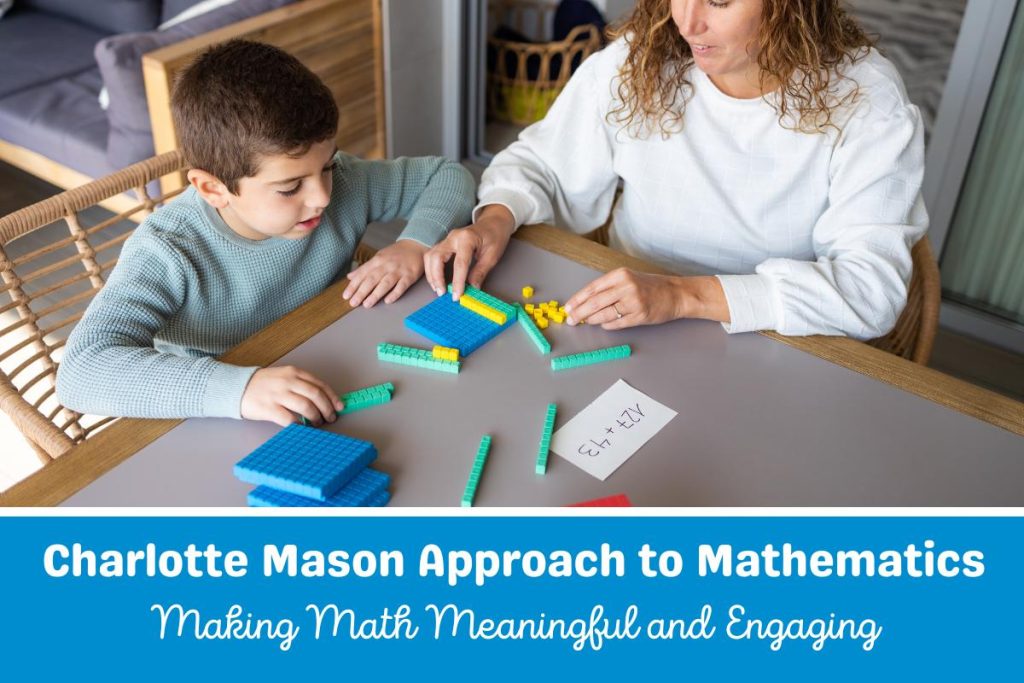
Incorporate the use of concrete manipulatives to aid in understanding mathematical concepts. Objects like base-ten blocks, counting cubes, fraction tiles, and geometric shapes can help children visualize and manipulate abstract concepts. These hands-on materials allow for a deeper understanding of mathematical operations, making math more tangible and concrete.
Read Next: Gentle Hands-on Mathematics at Home
Narration and Oral Expression
Narration helps solidify their understanding and enhances their ability to articulate mathematical ideas. Through oral expression, your child develops clarity of thought and strengthens their mathematical reasoning skills.
If you had sat with us at the table time mathematics sessions. Often I would be heard saying talk it out to me and I would do the same when explaining problems and correcting them. There is a downside to this as both my kids will still talk about their problems and are having to whisper or mouth it out. But it really does help.
Nature Study and Math
Integrate mathematics into your nature study sessions. Explore patterns, symmetry, shapes, and measurements found in nature. Engage your child in counting flowers, observing geometric shapes in leaves, or measuring the growth of plants. This connection between nature and math sparks curiosity and helps children recognize mathematical concepts in their surroundings. I found some fantastic ideas for Outdoor mathematics (and Literacy) that inspired us to explore nature and outdoors further.
Read more about Nature Study and the Charlotte Mason Method here!
Real Books and Living Books
Utilize real books and living books to introduce math concepts. Look for math-related literature that presents mathematical ideas in a narrative format. These books help children see the relevance of math in various contexts, making it more engaging and enjoyable. Some examples for kids include “Math Curse” by Jon Scieszka and “Sir Cumference” series by Cindy Neuschwander.
Math Games and Puzzles
Incorporate math games and puzzles as a fun way to reinforce concepts and develop problem-solving skills. Games like chess, Sudoku, logic puzzles, and math card games provide opportunities for critical thinking, strategy, and mathematical reasoning. These activities make math enjoyable and foster a love for mathematical exploration.
Individual Progress and Mastery
Charlotte Mason believed in allowing children to progress at their own pace and focus on mastery before moving on to new concepts. Encourage your child to master each concept before advancing, providing ample time for practice and reinforcement. This approach ensures a strong foundation and builds confidence in math skills.
When selecting our mathematics curriculum I choose one that had a mastery focus, challenging my kids to go deep into the concepts before moving on. One of the joys of home educating is that you have the time and flexibility to do this within your homeschool.
Charlotte Mason’s approach to mathematics encourages a meaningful and engaging learning experience for children. Embrace the principles to create a math curriculum that fosters curiosity, develops mathematical thinking, and brings joy to your home education journey.

