
Organizing your Homeschooling Space: Creating an Inspiring Learning Environment
Creating an organized and inviting space to home educate is essential for fostering a productive and engaging learning environment. It will help you streamline your daily routines as well as help your child to focus and thrive. I’m sharing some practical tips and ideas to help you organize your own space effectively so read on so you can create an inspiring learning environment for your kids.
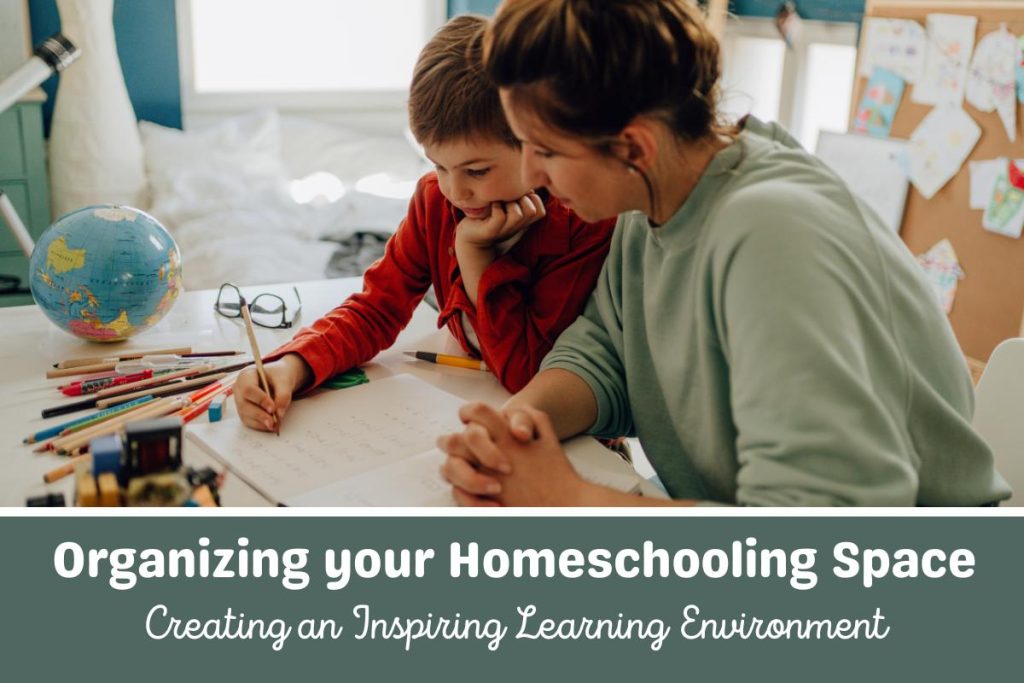
Once you’ve set your goals and vision for your families home education journey it’s time to get organised and start with where you are going to home educate. Now you’ve got to remember that people homeschool everywhere, boats, vans, homes and outdoors. It’s really up to you and your family. But there will always be some considerations.
Homeschooling Spaces
Do not start exploring homeschooling spaces on Pinterest before you read this article. They are lovely, I’m sure you will have seen them on Instagram as well. To be honest I’ve got a case of the green-eyed monster with a lot of them. Our homeschooling space was the kitchen table and a desk it was all the space we have available in our home.
In reality, you don’t need a lot of space and it is possible to integrate this into your home, however, if you have space and rooms to spare then go ahead now and browse to find what you can do. If you don’t then carry on reading let’s make an learning space in our homes that works!
Tips for Setting up a Learning Space for Home Education
1. Assess Your Space and Needs
Before you make a move begin by assessing what space you have available and if there are any areas that you can dedicate to home education. It could be a room (I wish!), a corner, a mobile set up (those Ikea trolleys are wonderful, we use them for our art supplies) you can find somewhere. Consider if you need a lot of space, how much table work will you be doing, what about reading, hands-on activities etc…
I decided a desk would fit in the corner of our kitchen and could have a mobile art trolley beside as well as some space on the bookshelves. It was all that we could accommodate.
But, when we home educated our kids when they were little, the space was very different, I had boxes with supplies and then that was it. Yes, we did some table work but much of the activities we did were on the floor, in different rooms or outdoors, we didn’t need a computer, or tables for written work.
As the kids got older they started to do some of the work in their rooms as well, listening to their own music, podcasts and audiobooks. Their desks were set up and supplies were given so that they could have space to concentrate without distraction.
Reading happened anywhere and everywhere for us, a conscious decision I made. I didn’t want to introduce that reading only happened at the table, in bed at night etc… Instead, we would read wherever we were.
2. Declutter and Simplify
Before you begin and regularly whilst you are home educating it’s worth sorting through your materials, books and supplies. Remove anything that is no longer useful, outdated or just doesn’t work. Try and keep only those things that you truly need, ignore all of the long lists of supplies that you will need to homeschool (I know I found some and was thinking WHAT!) but really to get started, a library card, writing implements, paper, printer and computer will start you off well.
Make sure that the space is clutter-free. It is really difficult for some kids to concentrate and focus on activities if there is lots of clutter around, other kids are fine, but things do get lost!
3. Utilize Storage Solutions
Storage solutions will help your homeschool environment stay clutter-free and make it easier for you and your kids to learn. Shelves, boxes and baskets are a great places to store books and manipulatives for maths as well as other materials. Art supplies as I said were always available and on a rolling trolley.
I wish I had added a peg board to the wall for organising writing materials and supplies so that the desk that the kids used and still use for homework would be clearer.
4. Create a Centralized Planning Area
I planned at the kitchen table for our home education journey but everything was in a central planning area – my folder/journal. It included the goals and vision we had set as a family, curriculum plans, to-do lists, book lists, calendars and more.
This was my little planning area, yours may be different maybe you have many folders for each year or a child or cabinet where everything is stored. If you have to produce reports centralising all of this makes it so much easier.
5. Comfort and Ergonomics
You may be in your space for a while! Although I never planned to spend a lot of time at the table with a more traditional homeschool approach. There were days when we found ourselves engrossed in a unit study, wanting to create something else and we sat at the table all day or the time my eldest produced a presentation on amphibians at the computer.
Having seating, a table and a desk that are supportive, and comfortable for all of us meant that that was possible. We used the lounge, beds and cushions outside in the garden to sit and read, draw and relax.
You don’t have to go and buy think about what you can use to make the environment somewhere you want to be. If you want to be there and feel comfortable and happy then chances are your children will too!
6. Inspirational Decor
Personalize your space with inspirational decor. Add quotes, posters, artwork, maps and your kids’ work. Our space had lots of photos from our travels, large artwork that we had completed as a family, and maps and artefacts that we had collected.
We also incorporated a nature table into the area only a small space that allowed the kids to display their nature finds and journals. It also became the location each spring to raise tadpoles, and butterflies in the summer and a location for our stick insects to be so we could observe them.
As you can see, you don’t have to have a dedicated room, even a small corner can be utilised for your home education space with some thought behind it. It will help to create an environment that your children want to be in to learn and somewhere you all as a family will enjoy spending time.
Once you have your space it’s time to think about your routines, schedules and plan your time to let your kids learn how you and they work best – read our guide to Planning your Time for Homeschooling.

